
Concrete Footing Calculator: Yards and Bags for Footings
A 20 ft footing 12 in wide and 6 in deep needs 0.37 cubic yards of concrete, or 0.41 yd³ with 10% extra, which is 19 bags of 80 lb mix.
Advanced options: waste, prices
NRMCA advises ordering 4 to 10 percent over the estimate.
Concrete needed (with 10% extra)
0.72 yd³
0.55 m³ · 17.78 ft³ before extra
Footing: 20 ft × 16 in × 8 in. Small pour: premix bags make sense.
Premix bags
- 80 lb33
- 60 lb44
- 50 lb53
- 40 lb66
- Ready-mix cost
- $116
- Weight
- 2,667 lb
Full breakdown
| Volume before extra | 0.66 yd³ · 0.50 m³ |
|---|---|
| With 10% extra | 0.72 yd³ |
| Weight (150 lb/ft³) | 2,667 lb · 1.33 tons |
| Pallets of 40 lb (80 bags each) | 1 |
| Pallets of 60 lb (56 bags each) | 1 |
| Pallets of 80 lb (42 bags each) | 1 |
| Truckloads at 12 yd³ | 1 |
| Truckloads at 8 yd³ | 1 |
Bag counts round up, as Quikrete's own calculator does. Cost uses your prices; delivery and short-load fees are extra.
Key takeaways
- Footings must be at least 12 in wide and 6 in deep (2021 IRC R403.1.1).
- Exterior footings sit at least 12 in below undisturbed ground and below the frost line (R403.1.4).
- A 20 ft footing, 12×6 in, takes 19 bags of 80 lb mix.
- Footings need at least 2,500 psi concrete (IRC Table R402.2).
How Much Concrete Do I Need for a Footing?
You need the footing's length × width × depth in feet, divided by 27, plus 10% extra. A 20 ft footing 12 in wide and 6 in deep holds 10 ft³, or 0.37 yd³ (0.28 m³). With 10% extra, that is 0.41 yd³, or 19 bags of 80 lb concrete.
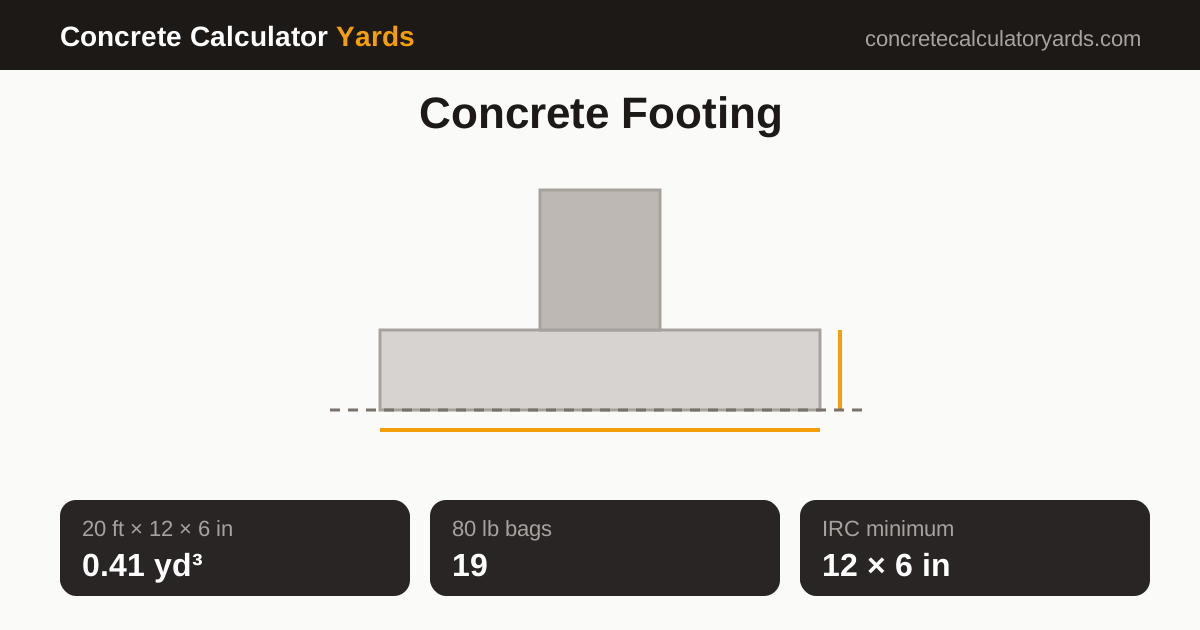
Concrete Footing Formula
Strip footing: yd³ = Length (ft) × (Width (in) ÷ 12) × (Depth (in) ÷ 12) ÷ 27
Round footing: ft³ = 3.1416 × (Diameter (in) ÷ 24)² × Depth (ft)
Use the strip formula for wall footings and the round formula for deck and post footings poured in tubes. The calculator's pier mode adds a square pad under a round pier.
How Many Bags of Concrete for Footings?
Footing bag counts below include 10% extra, rounded up.
| Project | yd³ with 10% | 80 lb bags | 60 lb bags | 50 lb bags | 40 lb bags |
|---|---|---|---|---|---|
| 20 ft × 12 in × 6 in | 0.41 | 19 | 25 | 30 | 37 |
| 20 ft × 16 in × 8 in | 0.72 | 33 | 44 | 53 | 66 |
| 40 ft × 12 in × 6 in | 0.81 | 37 | 49 | 59 | 74 |
| 10 in round, 4 ft deep | 0.09 | 4 | 6 | 7 | 8 |
| 12 in round, 4 ft deep | 0.13 | 6 | 8 | 10 | 12 |
Types of Concrete Footings: Strip, Pad and Pier
The three types of concrete footings differ in shape and in what they carry.
- Strip (continuous) footing: a long footing under a wall; volume = length × width × depth.
- Pad (isolated) footing: a square or rectangular block under one post or column.
- Pier footing: a round column of concrete, often poured in a form tube, sometimes on a wider pad.
The calculator has a mode for each type: footing (strip or pad), sonotube (round) and pier (round on a pad).
How Big Should a Concrete Footing Be?
A concrete footing must be at least 12 in (305 mm) wide and 6 in (152 mm) deep under the 2021 IRC (R403.1.1). Above that minimum, the code sets footing width from the load-bearing value of the soil (Table R401.4.1), and the footing must project at least 2 in past the wall but not more than the footing's thickness.
This calculator sizes concrete, not loads: check the local code tables or ask an engineer for anything beyond the minimum.
Concrete for Deck, Pergola and Post Footings
Deck, pergola and post footings are usually round, poured in a form tube. The table shows concrete per footing at 4 ft deep, with 10% extra.
| Tube diameter | ft³ per footing | 80 lb bags | 60 lb bags |
|---|---|---|---|
| 8 in | 1.40 | 3 | 4 |
| 10 in | 2.18 | 4 | 6 |
| 12 in | 3.14 | 6 | 8 |
Several footings of different sizes can be added as parts in the calculator. Tube sizes and bag counts per tube are on the sonotube calculator.
Will a 4 Inch Footing Hold Up a House?
No, a 4 in footing does not meet code for a house: the 2021 IRC requires footings at least 6 in (152 mm) deep and 12 in (305 mm) wide (R403.1.1).
What Strength Concrete for Footings?
Footings need at least 2,500 psi concrete, the 2021 IRC minimum for foundations not exposed to the weather (Table R402.2). Quikrete Concrete Mix (No. 1101) is rated at 4,000 psi, which clears that minimum.
Bags or Ready-Mix for Footings?
Bags suit deck footings and short wall footings, and ready-mix suits house footings above about 1 yd³, which is this calculator's own rule. A 100 ft footing at 16×8 in needs 3.62 yd³ with extra, which is a truck, not bags.
How Much Does It Cost to Pour Concrete Footings?
Footing concrete costs $160 to $195 per cubic yard for ready-mix (Concrete Network's national range). A 100 ft footing at 16×8 in costs about $579–$706 in concrete; excavation, forms and labor are extra.
How Deep Should a Footing Be?
Exterior footings must be placed at least 12 in (305 mm) below the undisturbed ground surface, and piers and foundation walls must extend below the local frost line from IRC Table R301.2, unless protected another way (2021 IRC R403.1.4). Your building department publishes the local frost depth.
Worked Examples: Three Footings
Garage wall footing, 88 ft perimeter, 16×8 in. 88 × 1.333 × 0.667 = 78.2 ft³ = 2.90 yd³; with 10% extra, 3.19 yd³, one ready-mix truck.
Pad footing for a post, 24×24×12 in. 2 × 2 × 1 = 4 ft³; with 10% extra, 8 bags of 80 lb mix.
Six deck footings, 12 in round, 4 ft deep. 6 × 3.14 = 18.85 ft³; with 10% extra, 35 bags of 80 lb mix, or 0.77 yd³.
How Much Does a 50 lb Bag of Concrete Fill?
A 50 lb bag makes 0.375 ft³ of concrete (Quikrete's yield), so a 20 ft footing 12×6 in (10 ft³) takes 30 bags of 50 lb mix with 10% extra.
Can You Pour a Footing Directly on Dirt?
Yes, footings are poured on undisturbed soil at the required depth; remove loose fill and organic material first. Slabs are different, see gravel under a concrete slab.
Footing Size Chart
The 2021 IRC sets the smallest footing and its depth; the soil and the load set anything larger.
| Rule | 2021 IRC value |
|---|---|
| Minimum footing width | 12 in (305 mm) |
| Minimum footing thickness | 6 in (152 mm) |
| Width basis | Soil load-bearing value (Table R401.4.1) |
| Footing projection | At least 2 in, not more than the footing thickness |
| Depth of exterior footings | At least 12 in below undisturbed ground and below the local frost line |
Deck post footings follow Table R507.3.1, by tributary area and soil bearing; see the deck footing calculator.
Concrete Footing Calculator FAQ
Will a 4 inch thick concrete footer hold up a house?
No, house footings must be at least 6 in deep and 12 in wide under the 2021 IRC (R403.1.1).
What is the rule of thumb for concrete footings?
Start from the IRC minimum of 12 in wide and 6 in deep, set at least 12 in below undisturbed ground and below the frost line; width then follows the soil bearing table (R403.1.1, R403.1.4).
How many cubic feet will a 50 lb bag of concrete cover?
A 50 lb bag makes 0.375 ft³ (Quikrete's yield).
Is it cheaper to buy bags of concrete or mix your own?
For small jobs premix bags are simplest; mixing your own from cement, sand and gravel needs about 7 bags of 94 lb cement plus aggregate per yard, and above about 1 yd³ ready-mix is usually cheapest. See bagged concrete vs ready-mix.
Next step
For deck posts, size each footing from IRC Table R507.3.1 on the deck footing calculator; for tubes, use the sonotube calculator.
Official sources
Last reviewed 2026-11-05. Numbers come from our tested engine; see how we calculate and our sources.